Is Your Business Website Costing You Enquiries? 10 Signs It’s Time for a Redesign
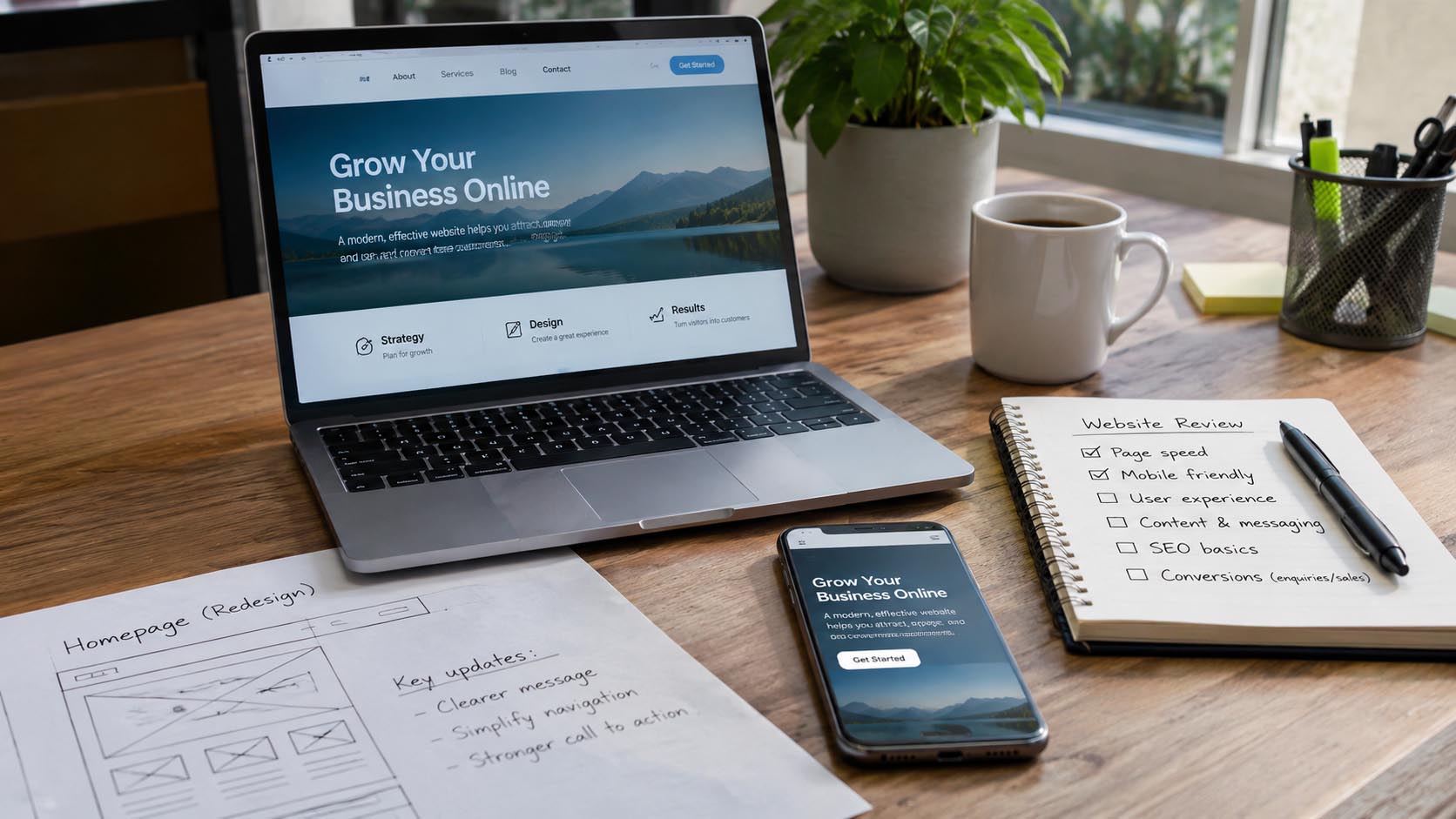
When was the last time you properly looked at your business website?
Not just checking that it’s still online or finding somebody’s telephone number. Actually sitting down, looking at it as though you were a potential customer, and asking yourself whether it’s doing the job you originally intended.
For a surprising number of businesses, the answer is probably some time ago.
Websites have a habit of being launched with a great deal of excitement before gradually slipping down the priority list. There’s always something more pressing to deal with, and if the website still works, why worry?
The problem is that a website can be working perfectly well from a technical point of view and still be doing very little for your business.
It might look respectable. All the pages might load. The contact form might even work. But is it actually attracting the right visitors, communicating what you do and encouraging people to get in touch?
If you’re not entirely sure, here are ten signs that your business website might be ready for a rethink.
1. Your Website Looks Better on a Computer Than a Phone
There’s nothing particularly unusual about a website looking impressive on a large desktop monitor. The challenge is making sure that same experience works on a smaller screen.
Try opening your website on your phone. Can you read everything comfortably? Are the buttons easy to press? Can you navigate around without constantly zooming in and out?
And, perhaps most importantly, can you find the information you need without getting annoyed?
Responsive web design isn’t simply about squeezing a desktop website onto a smaller screen. It’s about making the experience work properly on whatever device somebody happens to be using.
If your mobile visitors have to work harder than your desktop visitors, you may be making it unnecessarily difficult for them to become customers.
2. People Visit Your Website but Don’t Get in Touch
This is probably one of the more frustrating situations for any business.
You’re getting website traffic. People are visiting your pages. They might even be spending time reading about your services.
But the enquiries aren’t coming through.
There can be several reasons for this. Perhaps the website isn’t attracting the right audience, or perhaps visitors simply aren’t finding what they expect.
Sometimes, however, the problem is surprisingly straightforward.
- The contact details are difficult to find.
- The enquiry form asks for too much information.
- There isn’t a clear next step on service pages.
- The website doesn’t explain why somebody should choose your business.
- Visitors aren’t given enough confidence to make contact.
A good business website should make getting in touch feel like the natural next step.
It doesn’t mean filling every page with buttons or constantly asking people to request a quotation.
It means helping visitors understand what you offer and making it easy to take action when they’re ready.
3. Your Website Takes Too Long to Load
We’ve all been there.
You click a link, wait a few seconds, and watch as bits of the page slowly appear. Perhaps an image arrives first, followed by a heading, then something jumps across the screen just as you’re about to click it.
Eventually, you give up and go somewhere else.
Your customers can do exactly the same thing.
Slow websites can be caused by oversized images, unnecessary scripts, inefficient hosting, outdated themes and a variety of technical issues.
Not every performance problem requires a complete redesign, but consistently poor loading times are a good reason to review how your website has been built.
Website performance should be part of the design process, not something considered afterwards.
4. Your Website No Longer Reflects Your Business
Businesses change.
You introduce new services, employ more people, move premises, change your approach or start working with a different type of customer.
Yet the website can remain almost exactly as it was when you launched it.
Suddenly you’re sending people to a website that describes services you barely offer anymore, while important parts of your business hardly get a mention.
It might even contain photographs of staff who left years ago.
That’s not necessarily a design problem in itself. Sometimes the content simply needs updating.
But when a business has changed significantly, an older website might no longer have the structure needed to explain what it does.
Your website should represent the business you are today, not the business you were five years ago.
5. Visitors Have to Work Too Hard to Find Things
Here’s a useful exercise.
Ask somebody who doesn’t know your website to find a particular service, locate your contact details or explain what your company actually does.
Then watch what happens.
If they’re clicking backwards and forwards between pages, opening menus that don’t make sense or scrolling endlessly to find basic information, there’s probably room for improvement.
Navigation is one of those elements of web design that people rarely notice when it’s done well.
When it’s done badly, everybody notices.
Clear menus, sensible page structures and well-organised content make it easier for visitors to understand your services.
They also make it easier for search engines to discover and interpret your website.
6. Your Competitors Are Making a Better First Impression
Nobody wants to spend their life worrying about what the competition is doing.
But it’s worth paying attention occasionally.
Imagine somebody searching for a service that both you and a competitor provide. They open two websites in separate tabs.
One clearly explains the service, shows recent work, answers common questions and makes contacting the company easy.
The other has an outdated design, vague descriptions and little evidence of what the business actually delivers.
Which one is more likely to inspire confidence?
This isn’t about chasing the latest design trends or copying what other companies are doing.
It’s about making sure the quality of your website reflects the quality of your business.
7. You’re Struggling to Appear in Google
A good-looking website is only part of the picture.
If people can’t find it when they’re searching for your services, you’re potentially missing opportunities before somebody even reaches the homepage.
Search engine optimisation isn’t something you can solve simply by choosing a different font or changing a few colours.
It involves useful content, appropriate keywords, clear page structures, technical performance, internal links and a number of other factors.
Sometimes an existing website can be improved without rebuilding it.
But if important services don’t have dedicated pages, the navigation is confusing or the underlying website is difficult to maintain, a redesign may provide an opportunity to address those problems properly.
NECL considers the fundamentals of search engine friendly web design when planning and developing websites.
The objective is to create something that looks good for visitors while giving search engines a clear understanding of what each page is about.
8. Updating Your Website Is More Difficult Than It Should Be
Need to change a telephone number? Add a new service? Publish an article? Update a staff photograph?
None of these should be major projects.
Yet some businesses find themselves contacting a developer every time they want to make the smallest alteration.
Others are working with websites that have become so complicated that nobody wants to touch them.
That can lead to information becoming outdated and opportunities being missed.
A modern content management system should make routine updates straightforward for the people responsible for the website.
At NECL, we offer WordPress design, development and hosting services, creating websites around business requirements and helping organisations manage their online presence.
The easier a website is to maintain, the more likely it is to remain useful and relevant.
9. You Don’t Know Whether Your Website Is Working
You wouldn’t normally invest in advertising without wanting to know whether it produced any results.
Your website deserves the same attention.
Do you know how many people visit it? Which pages they use? Where they find you? Whether they complete your enquiry form?
If the answer is no, you’re making decisions without much information.
Tools such as Google Analytics and Google Search Console can help you understand different aspects of website performance.
Analytics can show how people interact with your website, while Search Console provides information about how your site appears in Google Search.
Neither tool tells the whole story, but together they can help identify potential weaknesses and opportunities.
A website redesign should have clear objectives.
More relevant visitors, better engagement, clearer navigation or more genuine enquiries are all more meaningful goals than simply making the website look different.
10. Your Website Has Become an Online Brochure Rather Than a Business Tool
There’s nothing wrong with having a website that explains who you are and what you do.
That’s an essential starting point.
But if that’s all the website does, it may not be achieving its full potential.
A useful business website should help answer questions, demonstrate expertise, explain services and build confidence.
Depending on the business, it might also support online bookings, e-commerce, customer enquiries or other useful functions.
It should also give visitors a reason to take the next step.
At NECL, our approach to web design and development is based on understanding what a business wants its website to achieve, then combining design and technology to support those objectives.
Because a website shouldn’t just occupy space on the internet.
It should earn its keep.
Does Every Older Website Need a Complete Redesign?
Not necessarily.
Sometimes a website simply needs better content, improved navigation, faster loading times or clearer ways for visitors to get in touch.
There is little value in replacing a perfectly workable website purely because it’s a few years old.
The important question is whether the existing website can continue to meet your business objectives, or whether it’s becoming an obstacle to them.
So, Is It Time to Rethink Your Website?
If you recognise one or two of the problems we’ve mentioned, don’t panic.
Most business websites have areas that could be improved.
The important thing is understanding which issues are genuinely affecting your visitors and your business.
Perhaps your website needs a few targeted improvements. Perhaps the content needs reorganising. Or perhaps the business has moved on so much that the existing design simply isn’t suitable anymore.
Whatever the case, the decision should be based on what your website needs to achieve, not simply how old it is.
And if your website is receiving visitors but rarely generating enquiries, that’s certainly worth investigating.
Could Your Website Be Working Harder for Your Business?
At NECL, we create responsive, user-focused business websites designed around real objectives.
From WordPress design and development to website reviews, hosting and digital marketing, we help businesses develop an online presence that supports their goals.
Whether you’re considering a complete redesign or simply want to understand what’s holding your current website back, we’d be happy to discuss your requirements.
EXPLORE OUR WEB DESIGN SERVICES
Or get in touch to talk about your website.